The 20-Minute Haircut That Changes Your Whole Face, The mid taper fade isn’t just a haircut. It’s a reliable, flexible foundation that works with your hair, your face, and your style. Learn the steps, bring a clear reference, and choose a barber you trust, and you’ll get a cut that looks great from day one to week three.
Here’s something barbers rarely say out loud: the same guy can walk in looking tired and walk out looking like a different person, and the only thing that changed was the sides of his hair. No new wardrobe. No gym transformation. Just a mid taper fade.
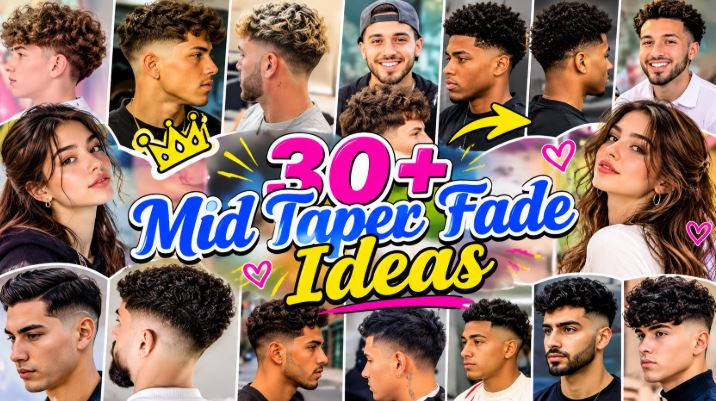
It’s one of the most searched men’s haircuts on Pinterest, and for good reason. It looks clean in an office, sharp on a night out, and works on almost every hair type. Whether you have straight hair, curls, a beard, or you want a blowout on top, there’s a version made for you.
In this guide you’ll learn exactly what a mid taper fade is, why it’s in such high demand, how each step is done, which version suits your hair, and how to ask for it without the dreaded “that’s not what I meant” moment.
And if you’re a woman or girl reading this because you’re choosing a cut for your boyfriend, brother, dad, or son, or because you love the look, keep reading. There’s a full section just for you.
What Is a Mid Taper Fade?
A mid taper fade is a haircut where the hair on the sides and back gets gradually shorter as it moves down the head, with the fade starting around the middle of the sides, roughly level with the temples and the top of the ear.
The key difference from other fades:
- Low taper fade: starts very low, near the ear and neckline. Subtle and conservative.
- Mid taper fade: starts at the middle. Balanced, clean, and noticeable without being extreme.
- High taper fade: starts high on the head. Bold and dramatic.
The word “taper” matters too. A taper keeps a little length at the very bottom, so the haircut looks softer and more natural than a skin fade, which goes down to bare skin.
Which Mid Taper Fits Your Face Shape?
| Face Shape | Best Style | Why It Works |
|---|---|---|
| Oval | Almost any version | Balanced proportions suit everything |
| Round | Mid taper with height on top, textured crop | Adds length and structure |
| Square | Classic mid taper, short or medium top | Softens and complements a strong jaw |
| Long / Oblong | Mid taper with less height, fuller sides or beard | Avoids elongating the face |
| Heart | Mid taper with a textured fringe or curls | Balances a narrower chin |
| Diamond | Mid taper with a fuller top and a trimmed beard | Softens cheekbones |
Why Everyone Is Searching for It Right Now
Demand for the mid taper fade has stayed strong because it solves problems people actually have:
- It’s versatile. It pairs with short crops, textured tops, curls, waves, and longer styles.
- It’s low risk. Not as stark as a high fade, not as plain as a low cut.
- It grows out well. Gradual blending means it doesn’t look messy after two weeks.
- It photographs well. That’s why it keeps showing up in saved pins, reference photos, and barber portfolios.
- It suits modern trends. Textured tops, natural curls, blowout styles, and groomed beards all combine easily with it.
Current trend notes: the most requested combinations right now are the mid taper with a textured crop, the mid taper with natural curls on top, the mid taper blowout, and the mid taper with a shaped beard. Trends shift quickly, so before you publish pins, check Pinterest Trends (trends.pinterest.com) for the latest search volume on each keyword, and update your titles to match.
Mid Taper Fade Variations at a Glance
| Style | Best For | Hair Length on Top | Maintenance | Vibe |
|---|---|---|---|---|
| Mid taper fade (classic) | Almost everyone | 1–3 inches | Every 2–3 weeks | Clean and sharp |
| Mid taper fade straight hair | Fine to medium straight hair | 2–4 inches | Every 3 weeks | Smooth and polished |
| Mid taper fade low cut | Minimalists, professionals | Under 1 inch | Every 2 weeks | Neat and low effort |
| Mid taper fade Black / Black male | Coily, kinky, and wavy textures | 1–4 inches | Every 1–2 weeks | Crisp lines, strong shape |
| Mid taper fade curly | Curly and wavy hair | 3–5 inches | Every 3–4 weeks | Natural and stylish |
| Mid taper fade blowout | Medium to thick hair | 3–5 inches | Every 3 weeks | Voluminous and confident |
| Mid taper fade with beard | Anyone who can grow a beard | Any | Every 2 weeks (beard blend) | Mature and defined |
How a Mid Taper Fade Is Done: Step by Step
Even if you’re not cutting hair yourself, knowing the steps helps you judge your barber’s work, ask smarter questions, and spot a great cut from a rushed one. Here’s what happens, and why each step matters.
Step 1: Consultation (The Step Most People Skip)
A good barber starts by looking at your head shape, hairline, hair texture, and growth patterns, such as cowlicks and crowns. They’ll ask how you style your hair day to day.
Why it matters: this is where the haircut is won or lost. A mid taper on a strong cowlick needs a different plan than one on flat, straight hair.
Step 2: Sectioning the Hair
The barber separates the top from the sides and back, usually with a clip or comb, and decides where the fade line will sit. For a mid taper, that’s around the temple and top of the ear, the “mid” point.
Why it matters: if the fade line is set too high or too low, you end up with a different haircut entirely.
Step 3: Setting the Guard Lengths
The barber chooses clipper guards for the gradual change in length. A common plan looks like this:
- Top of the fade: around a #3 or #4 guard
- Middle: #2
- Bottom: #1, or a #0.5 near the neckline for a tighter taper
The exact numbers change with your preference and hair type.
Step 4: Cutting the Base
Starting at the lowest section, the barber runs clippers upward and outward with a slight scooping motion. Working bottom to top lets them build the gradient rather than guess at it.
Why it matters: the “flicking out” motion at the end of each stroke is what prevents hard lines.
Step 5: Blending With Lever Work
This is the part that looks like magic. The barber opens and closes the clipper lever as they move up, softening the transitions between guard lengths. They often switch to a shorter guard or a clipper-over-comb technique to erase any remaining lines.
Why it matters: blending is what turns “short sides” into a true fade.
Step 6: Detail Work With Scissors
Scissors or thinning shears handle the zone where the faded sides meet the longer top, so there’s no sudden drop. On curly or textured hair, this is where the shape gets refined.
Step 7: Shaping the Top
The top is cut to match your style: textured crop, short and tidy, longer for a blowout, or defined curls. Length and layering here decide how the finished style behaves.
Step 8: Lining and Cleanup
With trimmers, the barber sharpens the hairline, the temples, and the neckline. If you have a beard, the beard fade connects here too.
Why it matters: crisp edges make even a simple cut look expensive.
Step 9: Final Check and Styling
A good barber checks both sides from several angles, adjusts anything uneven, and styles the top with product. Before you pay, ask them to show you the back and sides in the mirror.
Mid Taper Fade for Straight Hair
Straight hair shows every line, so the blend has to be clean. It also tends to lie flat, so the top needs some texture.
What to ask for: a mid taper fade with a textured crop or side part, with the top left around 2 to 4 inches.
Styling tips:
- Use a lightweight styling powder or sea salt spray at the roots for lift.
- Blow-dry the top upward and slightly to the side before applying a matte clay.
- Avoid heavy gels on fine hair. They’ll weigh it down and make it look greasy.
Mid Taper Fade Low Cut
If you want the cleanest, lowest-effort version, ask for the mid taper with a short top, often a #2 to #4 guard all over the top.
Who it suits: students, busy professionals, athletes, and anyone who wants to wake up and go.
Pro tip: a low cut shows the shape of your head, so tell your barber if you have flat spots or an uneven crown. They can adjust the fade height to balance it.
Mid Taper Fade for Black Men (Black Male Styles)
The mid taper fade is a staple for coily and kinky hair textures, and it can look incredibly sharp when done well. Texture changes how you approach the cut, so look for a barber with plenty of experience with it.
Popular combinations:
- Mid taper with waves: brushed and moisturized so the wave pattern shows.
- Mid taper with a sponge twist or coils on top: defined, textured, and stylish.
- Mid taper with a shape-up: a sharp hairline and temple line.
- Mid taper with a part: a razor-line part adds a modern detail.
Care tips:
- Moisturize regularly. Dry hair looks dull and cuts less cleanly.
- Sleep with a durag or satin cap to protect waves and reduce frizz.
- Visit your barber every 1 to 2 weeks if you want edges to stay crisp.
Note on razor bumps: if you get ingrown hairs, ask your barber about the direction of clipper work, and use a gentle exfoliant and a soothing aftershave.
Mid Taper Fade for Curly Hair
Curls and tapers are a fantastic pair: the controlled sides make the curls on top look intentional and defined.
What to ask for: a mid taper fade with 3 to 5 inches of length on top and the curls left natural, with light layering to control volume.
Styling steps:
- Apply a curl cream or leave-in conditioner to damp hair.
- Scrunch upward to encourage curl shape.
- Air dry, or use a diffuser on low heat.
- Avoid brushing dry curls. It creates frizz.
Why it works: the fade removes bulk at the sides, so curls don’t triangle out.
Mid Taper Fade Blowout
The blowout is where the mid taper turns into a statement. Volume on top, clean sides, and a lifted front give a bold, modern look.
What to ask for: a mid taper fade with 3 to 5 inches on top, layered so it holds a lifted shape.
How to style it:
- Towel-dry hair until just damp.
- Apply a sea salt spray or volumizing mousse.
- Blow-dry the top up and back with a round brush or your fingers.
- Finish with a medium-hold clay or paste.
- Set with light hairspray if you want it to last all day.
Mid Taper Fade With a Beard
This is the combination that makes people say, “Who is he?” The faded sides flow into the beard, so the whole look reads as one smooth design.
Key details:
- The beard fade should connect smoothly with the sideburn area.
- The beard’s shape should match your face: a fuller beard for longer faces, a tighter line for rounder faces.
- Keep the neckline clean, about one finger width above the Adam’s apple.
Maintenance: trim the neckline weekly and book a beard blend with every haircut.
For Women and Girls: What You Should Know
More women than you might expect search for mid taper fades. Here’s why, and how this guide helps you.
If You’re Choosing a Cut for Someone Else
If you’re picking a haircut for your boyfriend, husband, brother, dad, or son, send your barber a photo, and say: “mid taper fade, not too short on top, blended with the beard.” A photo is more reliable than a description every single time.
What Women Often Say They Notice
Preferences are personal, so there’s no universal answer. But commonly mentioned things include:
- Clean edges and a fresh neckline. It signals effort and care.
- A cut that suits his face. A good fit matters more than a trendy one.
- Healthy, styled hair. Texture and grooming beat length.
- A well-shaped beard. Defined lines look intentional.
If You Want the Look Yourself
Tapered sides are also popular on women’s short cuts, including pixie cuts and undercut styles. If you’re considering a tapered pixie, ask for a taper rather than a skin fade, bring a reference photo, and choose a stylist with experience in short cuts.
If You’re Cutting at Home
Plenty of moms and partners trim at home. Start with longer guards than you think you need, since you can always cut more but can’t add it back. Take your time with the blending step, and consider a professional shape-up afterward.
How to Ask Your Barber (Copy and Paste Script)
Print this or save it on your phone:
“I’d like a mid taper fade, starting at about the temple. Leave the sides at a #1 at the bottom, blending up to a #3. Keep [length] on top, and style it [textured / curly / blowout / side part]. Please blend it with my beard and clean up the neckline. Here’s a reference photo.”
A vague request leads to a vague haircut. Specifics lead to results you’ll actually like.
7 Mistakes That Ruin a Mid Taper Fade
- Wrong fade height. Too high makes it look harsh, too low makes it look unfinished.
- Skipping the consultation. Your hair type changes the plan.
- Rushed blending. Visible lines are the number one complaint.
- Ignoring the crown or cowlick. It can make the top sit awkwardly.
- Poor neckline shape. A bad neckline makes a great fade look cheap.
- Waiting too long between cuts. Fades lose their shape quickly.
- Using the wrong product. Too heavy or too shiny can ruin the finish.
Maintenance Schedule
| Time Since Cut | What to Do |
|---|---|
| Daily | Moisturize or style, depending on hair type |
| Every 3 to 4 days | Light neckline and edge touch-up if needed |
| Weekly | Beard trim and neckline clean-up |
| Every 2 to 3 weeks | Full mid taper fade refresh |
| Monthly | Reassess length on top and style |